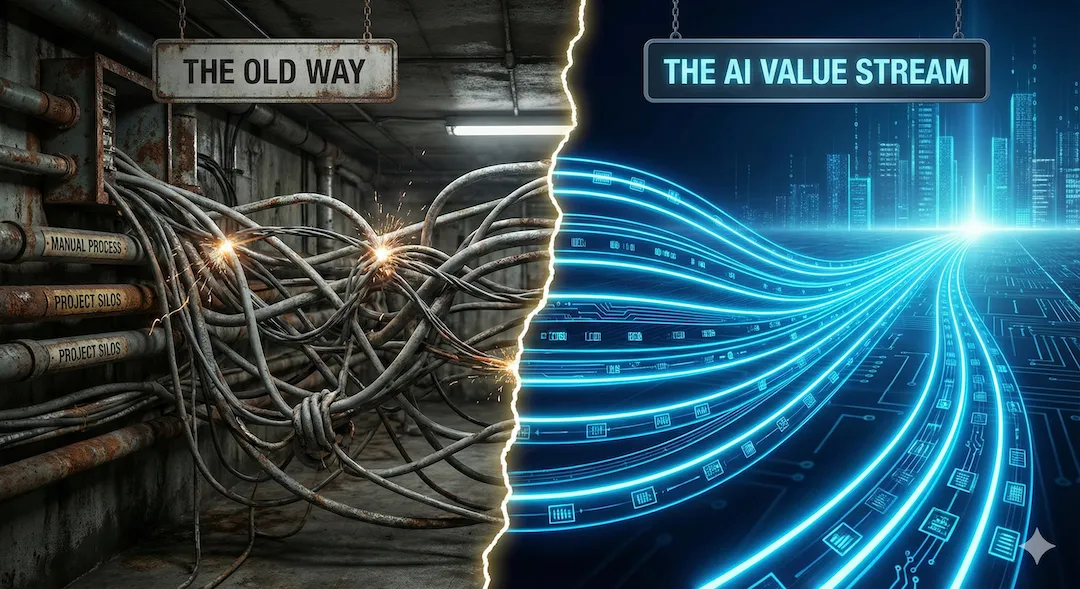
AI Will Supercharge Your Value Stream, But Only If You Fix Your Architecture First
We often talk about AI writing code, but its real power lies in managing the flow of value. The catch? You can't apply a Ferrari engine to a horse-drawn cart. Here is why organisations must restructure to unlock the AI advantage.
The New Promise of Flow
When we talk about AI in software delivery, the conversation usually stops at the IDE. We obsess over GitHub Copilot writing boilerplate code or LLMs drafting unit tests.
While these gains are real, they are local optimisations. Making a developer type 20% faster doesn’t mean the customer gets value 20% sooner, especially if that code sits in a queue for two weeks waiting for approval.
The true revolution isn’t in code generation; it is in Flow Intelligence.
AI is arguably the first technology capable of seeing the “invisible” parts of a value stream. It promises to predict bottlenecks, quantify delays, and orchestrate context across teams. But before we get carried away with the technology, we have to acknowledge an uncomfortable truth: we have known how to fix delivery for years, and we still haven’t done it.
The Manuals We Ignored
The concept of the Value Stream is not new. It has been a staple of Lean manufacturing for decades and has been discussed in software circles for nearly as long.
The “gold standard” texts on this topic have been sitting on our bookshelves for years:
- Mik Kersten’s Project to Product meticulously outlines why the project model fails in the Age of Software and provides the Flow Framework to fix it.
- Donald Reinertsen’s The Principles of Product Development Flow provides the mathematical and economic foundation for managing queues, batch sizes, and Cost of Delay.
Despite this wealth of knowledge, true adoption has been poor. Most organisations still pay lip service to “Agile” while maintaining rigid, project-based governance structures.
What is new, however, is that AI has changed the calculus. Previously, implementing Flow required immense manual effort to gather data and police processes. Now, AI offers a game-changing capability to make Flow visible, predictive, and actionable, but only if the underlying streams are constructed correctly.
A Reminder: What Do We Mean by Value Streams and Flow?
Before we look at the potential AI advantage, it is worth reminding ourselves of the fundamentals.
In system development, a Value Stream is simply the sequence of activities required to deliver a product or service to a customer. It starts when a request is made (or a market opportunity is spotted) and ends only when value is realized in the hands of the user.
Flow is the measure of how easily work moves through that stream. In a healthy system:
- Flow Velocity is high (value is delivered frequently).
- Flow Efficiency is high (work isn’t sitting in wait states).
- Flow Load is managed (teams aren’t drowning in WIP).
If you view your organisation through this lens, you stop managing people (resources) and start managing the work itself.
How AI Supercharges the Stream
If you have a defined Value Stream, AI becomes the ultimate accelerator.
1. Predictive Visibility
AI agents can ingest signals from disparate tools (Jira, GitHub, Slack) to construct a high-fidelity map of your stream. It can analyse Flow Load and historical throughput to predict bottlenecks before they form.
2. Dynamic Cost of Delay
Reinertsen teaches us that Cost of Delay is the key to economic decision-making. AI can finally make this practical. Instead of a theoretical debate, an AI agent can flag a stalled feature and quantify exactly how much potential revenue is being lost every hour it sits in “Ready for QA.”
3. Context Orchestration
AI can carry the “context payload” through the stream. It can synthesize user research from the discovery phase directly into acceptance criteria for delivery, ensuring the “why” never gets lost as the work flows to the “how”.
Why You Aren’t Ready for AI-Driven Flow
You cannot supercharge a system that is fundamentally broken. The reason most organisations cannot leverage AI for flow optimisation isn’t a lack of tools; it is a lack of autonomy and structural alignment.
The “Feature as a Project” Trap
Many organisations have stable teams, they don’t fire and re-hire developers for every release. However, they still force these stable teams to operate within a Project Funding model.
Instead of funding a continuous stream of value, the business funds a “Feature Release” as a distinct project. As Kersten argues, this forces teams to batch work into massive, high-risk releases to justify the budget.
AI thrives on small batch sizes. If your governance model forces you to stockpile six months of code into one “Big Bang” release, AI cannot help you. It can predict the date you will miss, but it cannot fix the risk inherent in the batch size.
Architecture That Blocks Autonomy
Even if you have a “Product Team,” do they actually own the full vertical slice of their value stream?
Often, a team is responsible for a product but lacks the architectural autonomy to deliver it. They might own the application code but depend on a central “Platform Team” for infrastructure, a “Data Team” for schema changes, and a “QA Team” for testing.
These dependencies are flow killers. If a team cannot deploy what they build without three other teams signing off, the value stream is severed. AI can visualize this blockage, but it cannot write the code to decouple your monolith.
What do we do then?
AI offers us the chance to finally solve the “visibility problem” in software delivery. It promises to turn the lights on in the factory, revealing exactly where value is leaking.
But technology amplifies the underlying habits of an organisation. If you apply AI to a well-architected value stream, you can achieve unprecedented speed and adaptability. If you apply it to a bureaucracy of gated releases and dependencies, you will just hit the wall faster.
The blueprints for success, written by Kersten and Reinertsen—have been available for years. AI is simply the urgent wake-up call to finally read them.