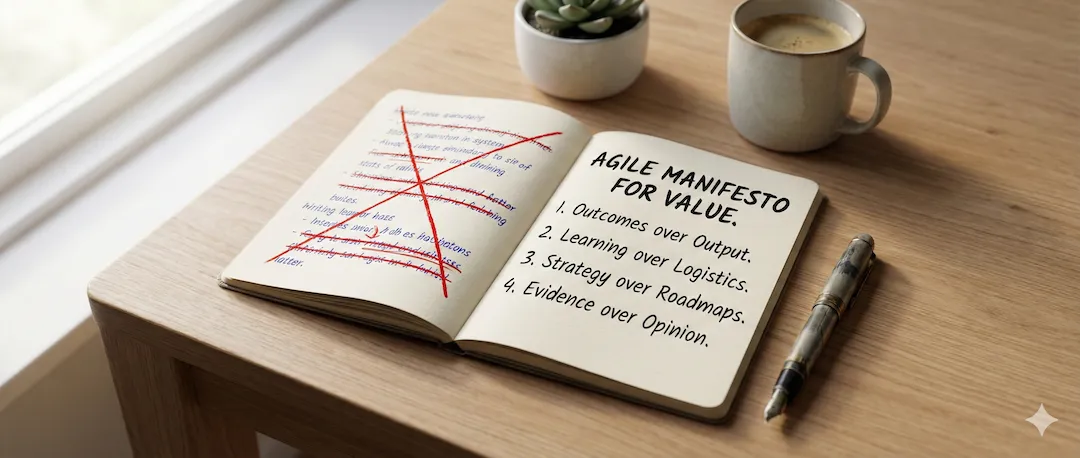
A Product Management Manifesto for the AI Era
Agile won the war on delivery, but we are losing the peace on value. It is time for a new set of values that prioritises outcomes over outputs and learning over logistics.
The Agile Manifesto Won the War on Delivery. Now We Need One for Value.
In 2001, seventeen software engineers met in a ski lodge in Utah and changed the world. The Agile Manifesto was a rebellion against heavy-handed documentation and rigid planning. It was necessary, it was effective, and it fundamentally solved the problem of how to build software.
But twenty-five years later, we face a different problem.
Agile frameworks have been so successful that “delivery” is often commoditised. We can ship code faster than ever. And now, with the arrival of Generative AI, the cost of producing code, content, and features is trending toward zero.
The bottleneck has shifted. The challenge today isn’t can we build it? The challenge is should we build it?
A Return to Essence, Not a New Definition
To be clear: Prioritising value over volume has always been the true role of a Product Manager.
The best Product Managers have always understood that velocity is a metric for output, not outcomes. They knew that you could double your speed and still build something nobody wanted.
However, for the last two decades, the sheer difficulty of software delivery gave the industry an excuse. It was easy to drift into the role of “Backlog Administrator”, spending days writing tickets, managing Jira, and “feeding the beast” of engineering. It was dysfunctional, but it was considered necessary work.
That excuse is now gone.
In the AI era, the “tactical ladder” of ticket writing, summarising interviews, and basic analysis is being automated. If your primary contribution is moving tickets around a board, an agent will soon do it faster and cheaper.
This manifesto is not about inventing a new job. It is about stripping away the administrative safety blanket and focusing on the only thing that has ever really mattered: judgement, strategy, and the definition of value.
The Shift: From Delivery to Value
We respect the original four values. They ground us in the reality of software creation:
- Individuals and interactions over processes and tools
- Working software over comprehensive documentation
- Customer collaboration over contract negotiation
- Responding to change over following a plan
But for Product Managers – especially those grappling with the speed and uncertainty of AI – we need to overlay a new set of priorities.
1. Customer & Outcome Learning over Backlog Administration
The most valuable time a PM spends is with the problem, not the ticket. We must get close to customers, frame the outcome, and decide how we will measure success. Backlog hygiene matters, but only as a means to an end. We must pair product outcomes (activation, retention, NRR) with delivery health (lead time, deployment frequency) to tell the complete story: “We shipped this, and it improved that”. Refs: DORA, Accelerate
2. Validated Value over Shipped Features
A feature isn’t valuable because it shipped; it’s valuable because it changed user behaviour. In the AI era, this is doubly true. “Done” is no longer just code in production; it includes clean data, pre-agreed evaluation thresholds, and safety guardrails. We value the evidence of impact more than the volume of output. Refs: Model Cards, AI PRD
3. Continuous Collaboration over Periodic Alignment
Quarterly planning is too slow for modern product work. We value a steady, “little and often” rhythm of orchestration between customers, engineering, data science, and compliance. We prefer short discovery loops and frequent, transparent updates over “big bang” alignment meetings that are obsolete the moment they finish. Refs: INSPIRED, Project to Product
4. Adaptive Strategy over Fixed Roadmaps
Strategy is a set of bets, not a set of certainties. In a world of fat-tail risks and rapidly evolving AI capabilities, assumptions rot quickly. We treat the roadmap as a living hypothesis tied to outcomes, reserving the right to adjust scope and sequence as we learn. We value the agility of our direction more than the fidelity of our Gantt chart. Ref: Fat-tail uncertainty
12 Principles for Modern Product Management
If those are the values, how do we live them? Here are 12 principles to guide the daily work of a Product Manager in 2025.
1. Start with problems, frame outcomes. Begin every initiative by writing the customer problem in plain English. Identify who is affected and how you will measure “better.” If you can’t articulate the success metric – activation goes up, friction comes down – you aren’t ready to build.
2. Flow and Value are inseparable. Engineering capability and commercial results are linked. Make this visible. Review DORA metrics (how fast we ship) alongside product KPIs (how much value we create). When delivery slows, outcomes suffer. You cannot manage one without the other.
3. Decide with evidence, not opinion. Replace long debates with small tests: a prototype, a concierge trial, a fake-door prompt. Agree on the thresholds before you test – know what “pass” and “fail” look like before the data comes in to prevent post-hoc rationalisation.
4. Shape small bets; sequence by risk. Break work into thin slices that prove the riskiest assumptions first. Whether it’s legal constraints, API latency, or user willingness-to-pay, tackle the “unknowns that can kill you” before polishing the UI.
5. Make AI “Definition of Done++”. If you are building with AI, “done” means more than “it works on my machine.” It requires documented data lineage, clear offline benchmarks, online success metrics, and safety guardrails. Operations should be boring – write the docs to keep them that way.
6. Organise by value streams, not projects. Fund durable teams that own a customer outcome end-to-end. Avoid short-lived projects that treat teams like mercenaries. When a team owns the long-term result, they make better long-term decisions.
7. Roadmaps tell the story, not the secrets. Use “Now/Next/Later” to signal direction without locking yourself into a lie. Stakeholders need to know the goals and the guardrails, but the specific features should emerge from discovery. Build trust through transparency, not false certainty.
8. Prioritise capabilities over ceremony. The best teams aren’t faster because they have better meetings; they are faster because they invest in architecture, automated testing, and feature flags. Invest in the machinery that reduces the cost of experimentation.
9. Design for responsible impact. Users judge products by how they behave on their worst day. Bake privacy, safety, and explainability into discovery. Ask: “What is the worst plausible misuse of this?” and build the mitigation before you launch.
10. Make trade-offs explicit. Every choice has a cost. Write down the options considered (e.g., Build vs Buy, Fine-tune vs Prompt Engineering) and why you chose your path. A short “Decision Record” saves months of re-litigation later.
11. Teach the organisation to learn. Hold short reviews that focus on what we learned, not just what we did. Celebrate the null results – experiments that failed early save the company money. Share the learning, not just the launch.
12. Lead with clarity and kindness. PMs often lack formal authority, so our superpower is shared understanding. Be precise with language, generous with credit, and assume good intent. People follow leaders who make the complex feel manageable.
The Steward of “Why”
The original Agile Manifesto was a reaction to a time of scarcity, where shipping software was difficult, expensive, and slow. Its principles were designed to remove friction.
Today, we face a crisis of abundance. AI and modern tooling have made the act of creation easier than ever. The barriers to entry have collapsed. But this ease of creation brings a new danger: the ability to build the wrong things, faster and with more confidence than ever before.
This is the turning point for Product Management. The tactical ladder of ticket-writing and backlog administration is disappearing. What remains is the harder, more human work: judgement, orchestration, ethics, and the courage to stop a feature that adds no value.
We must stop pretending we can predict the future with Gantt charts and instead build the capability to respond to it. We must move from being the managers of schedules to the stewards of value.
That is the manifesto for the next age. Not just to work faster, but to work with purpose.